Familiar at the station
If you run WSJT-X, JTDX or any of their variants, the station setup feels familiar — the same rig, CAT and audio configuration you already do. No new workflow to learn.
 DMROS
DMROS
Remote FT8 / FT4 operation
DMROS — the Digital Modes Remote Operating System — easy, lightweight remote operation, never miss a DX-pedition or a rare IOTA popping up on the cluster just because you're away from the shack.
Set your station up the way you already know, then just open a browser to operate it from anywhere. Or operate a club or friend's station with better antennas and no RFI.
For licensed operators — your callsign keeps the early-access list real. No spam. By signing up you agree to our Privacy Policy.
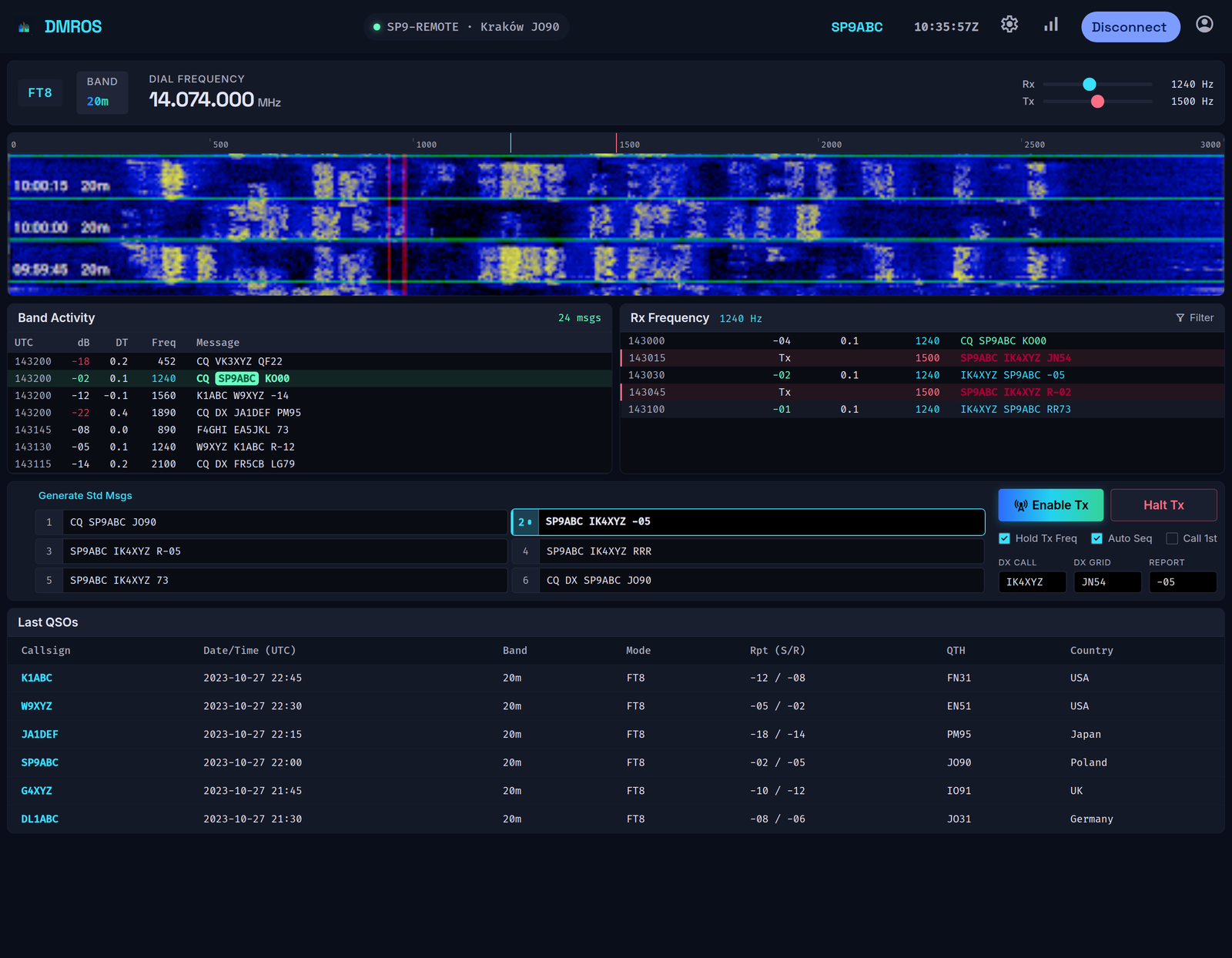
You're at work, travelling, or just away from the radio when a DX-pedition fires up or a rare one shows on the cluster. On FT8 and FT4 you'd have a real shot at a QSO - if only you could get on the air. DMROS puts your station in any browser, even your phone, so you work it from wherever you are.
And if your location is the problem - HOA or antenna restrictions, an apartment or balcony station, city RFI that buries the band - put a station somewhere with room and quiet, and operate it from home or on the road. Or do it together, as a club.
Or simply operate your own station from the sofa or the office - in your browser, with no remote desktop, no audio tunnel, no fragile chain to babysit. For many operators, that ease alone is reason enough.
Reaching your own station from elsewhere today usually means a tangle of virtual audio cables, a virtual COM port for rig control, audio streaming that stutters when you least want it, and a public IP at the station - or just leaving WSJT-X running and remote-desktopping in. A multi-page setup guide and a fragile chain, to do something that's already fully digital.
If you run WSJT-X, JTDX or any of their variants, the station setup feels familiar — the same rig, CAT and audio configuration you already do. No new workflow to learn.
Your operating position is a web page — open it on any computer, tablet or even phone, anywhere. No drivers, no virtual cables, no client software.
Fully digital modes mean DMROS sends only decoded data, your commands and a light waterfall to the device you operate with — a tiny fraction of the bandwidth, with nothing to stutter.
The station works via DMROS servers, so it runs from an ordinary home connection behind NAT — no port-forwarding, no public IP address to worry about.
A quiet location and a decent antenna are worth sharing. DMROS lets you host your station also for your friends, other hams in your family or your club - you always stay in control of who operates and when.
DMROS is software, not a station service - you bring the radio and the location; DMROS is the operating position and the link.
Register your interestDMROS is in active development, built by a ham for hams.